Saturday, June 29, 2013

Summer Sermon Series–Sifted

clip_image002

On of the most familiar verses in the Bible is Romans 8:28 — “And we know that for those who love God all things work together for good for those who are called according to his purpose.” While that verse is true, the reality is that we often have to face trials, challenges, and disappointments in order to experience the good that God can bring to anything that we face in life.

So on Sunday, June 20, as we take a summer break from The Story, I will begin a seven-week sermon series titled: “Sifted: Pursuing Growth Through Trials, Challenges, and Disappoints.” The focus of the series is to help us face the hard things in life by examining our walk with God through the lives of seven Bible characters who faced their own challenges:

  • Simon Peter denied Jesus three times during the night leading to Jesus’ crucifixion, only to be restored by Jesus after the resurrection on the way to becoming the leader of the early church.
  • Job lost everything in the prime of life, was blamed for his loss by three friends, before learning the greatness and power of God that is available for every circumstance in life.
  • Jacob deceived his family multiple times, and then had some remarkable encounters with God that changed his life.
  • Moses was taught — and humbled — by working as a shepherd in the sands of the Sinai, only to become the great leader God used to rescue his people from slavery in Egypt.
  • Jonah tried to run from God and spent three days in the belly of a large fish, before God transformed him and used him to bring many in the city of Ninevah to repentance.
  • John the Baptist questioned whether Jesus was the one God had sent to deliver his people, but Jesus recognized him as one of the greatest in the Kingdom of God.
  • Jesus suffered great temptations in the wilderness at the beginning of his ministry and the rejection of God as his crucifixion, only to defeat death forever by rising from the dead.

I trust that, over the course of the summer, these seven individuals will speak to your life and the trials, challenges, and disappoints that you face.

Summer Preaching at Westwood

clip_image002

In June, July, and the first half of August, we will take a break from The Story in our Sunday worship, children’s classes, and adult Bible classes and studies. We will return to The Story on August 18.

We will begin the summer with three guest preachers at Westwood on the first three Sundays of June while Christine and I travel overseas. We leave on May 31 and fly to Rome, from where we will embark on a cruise to visit the sights of the Apostle Paul’s missionary journeys, including Rome, Ephesus, Corinth, Athens, and several others. We will return home on June 15.

Marion and Marilyn Greaser will be on the cruise with us. Carl Ferguson, the preacher at Waupaca Christian Church, and his wife, Deb, will also be traveling with us. We are all looking forward to having a remarkable adventure.

The three preachers during our travels will be:

  • June 2 — Lance Hawley, who for a few years led a church here in Madison known as Emmaeus Fellowship and which participated in our first three annual Great Communion services, will preach. Lance is currently a member at Mandrake Road Church of Christ and a Ph.D. student in the Department of Hebrew and Semitic Studies at UW.
  • June 9 — Tom Jones, who has preached at Westwood a few times in the past, will preach. Tom held long-term ministries in Green Bay and Brookfield and was a chaplain in the Aurora Health System in Milwaukee.
  • June 16 — Bud Holmes, Christine’s brother, will preach. Bud had a long-term ministry at Lake Superior Christian Church in Marquette, MI, where I enjoyed preaching for him several times.

I have asked each of them to preach from a story in the Bible with an emphasis on how that story weaves into the Upper Story of the Bible.

Beginning June 23, I will preach seven sermons around the theme “Sifted: Pursuing Growth Through Trials, Challenges, and Disappointments.” This series is intended to help us understand how God uses the tough things we face in life to build our character and our trust in him. I will develop each sermon around the life of a Bible character whose faith was challenged and strengthened through personal challenges and temptations.

The premise of this series is built on Luke 22:31-32: “Simon, Simon, behold, Satan demanded to have you, that he might sift you like wheat, but I have prayed for you that your faith may not fail. And when you have turned again, strengthen your brothers.” Jesus was speaking to Simon Peter. Satan would indeed sift Peter like wheat as Peter would deny Jesus three times before that night was over. God, however, would use Peter’s sifting to make him stronger, so that he would lead the church beginning on Pentecost.

We all go through difficult seasons in life during which God sifts us like wheat. We might wish that those times were optional or that we would not have such times at all, but we do. God, however, can use the difficulties we face — even the most painful ones — to make us stronger. We will learn this summer from seven characters in the Bible how God can use such sifting times to strengthen us.

Sunday, May 5, 2013

Read The Story – Experience the Bible

clip_image002

We are just past the halfway point of our look at this year’s series in The Story. From June through mid-August, we will take a summer break from The Story, so it is a good time to review.

So, let me take you back to three goals that I placed before you at the beginning of our journey through The Story and ask you to reflect on your progress with each goal:

1. Know the Story: Do you know the story of the Bible better than when we started? Are the stories of the Bible beginning to fit together with the Upper Story of the Bible — the story of what God is doing in the world?

Here are two measuring sticks for analyzing how well you know God’s story: Are you able to in ten minutes or less give someone an overview of the story of the Bible, and can you place the main characters of the Bible that we have studied to this point in their place in Bible history?

Don’t worry if you don’t know everything in the Bible. I have been studying the Bible my whole life and keep coming across things that I have not seen before. In fact, it happened to me just this week. We can all keep working, though, to know The Story better.

2. Read the Story: Are you using the book, The Story, to read the one chapter each week that covers the story of the Bible that I am preaching on that week and that we are studying in our Bible studies and children’s classes?

Don’t just read the Bible from The Story this year in order to follow along with the messages each week, though. If you do not so now, determine to make daily reading of the Bible a regular practice in your life. I continue a long-time practice of reading through the entire Bible every year. That has been a good discipline for me. I use different reading plans and different Bible versions as I do so and thereby get different perspectives on the Bible stories and the Bible’s teachings.

This is much easier to do now because there are several Bible apps for our computers, phones, and other devices that have different versions and reading plans included. You may choose to read the Bible differently than I do, but it is important that you read it and re-read it.

3. Live the Story: Do you use the Bible to guide your life? The apostle Paul gave instructions in this regard to Timothy: “Do your best to present yourself to God as one approved, a worker who has no need to be ashamed, rightly handling the word of truth” (2 Timothy 2:15). As we live and look forward to being with the Lord, we need to shape our lives by the instruction of God’s Word.

When we know the nature of the Word of God, we really have no choice but to live to fulfill these three goals. Paul described the Word of God like this: “All Scripture is breathed out by God and profitable for teaching, for reproof, for correction, and for training in righteousness,  that the man of God may be competent, equipped for every good work” (2 Timothy 3:16-17).

This is a lifelong challenge and these are lifelong goals, but making God’s Story part of our lives makes our stories part of his Story.

Wednesday, March 27, 2013

What Do Americans Really Think About the Bible?

clip_image002

We are emphasizing the story of the Bible at Westwood this year as we explore The Story together. Many of you know that The Bible miniseries on the History channel has drawn the attention of many people in the country to the Bible as the miniseries is being broadcast this month. The miniseries is setting records for the number of viewers for a non-sports cable TV show.

Now the Barna Group, a Christian research firm, in a survey commissioned by the American Bible Society, has provided insight into questions concerning how Americans view the Bible: What do Americans actually think about the Bible? Do they believe it to be sacred, authoritative or merely nonsense? Do they try to follow its exhortations, or do they regard the Bible as antiquated literature? Does the Bible still matter—besides television ratings—to Americans?

clip_image002[5]

The Barna report on their survey concludes, “It’s easy to see why the Bible remains a cultural force in the United States. Yet, its future role looks very different than its past.“

Here are a few of the findings in the Barna survey:

  • 88% of Americans own a Bible. That is a slight decline from 1993 when 92% of Americans owned a Bible.
  • On average, American Bible owners have 3.5 Bibles in their home, and 24% of Bible owners have six or more.
  • 79% of Mosaics (people aged 18-28) own a Bible, compared with 95% of Elders (who are ages 65-plus).
  • It is not surprising that devoted Christians own Bibles, but the study finds that 59% who have no faith or who identify as atheists own a Bible.
  • 80% of Americans identify the Bible as sacred literature, without any prompting from interviewers. That proportion has dipped from 2011, when 85% of respondents affirmed this perspective of the Bible.
  • The above item may explain why 61% of American adults also say they wish they read the Bible more.

There is much more information in the Barna survey. If you would like to read more, go to www.barna.org, and follow the link to “What Do Americans Really Think About the Bible?”

This leads me to suggest to you that one way to share your faith with others is to encourage them to read the Bible. The story of the Bible has captivated people for many years, and continues to do so. Share with people your interest in the Bible and how reading it has affected your life. Tell people about how we are going through The Story this year, and encourage them to buy a copy (or give them one) and read it.

People sometimes ask me where to begin reading in the Bible. I tell them to begin with one of the Gospels — and I suggest they begin with Luke. Luke wrote to people seeking to find God, and his Gospel can still show people the way to God through Christ. Keep on learning from the Bible, and encourage other people to read the Bible and find their way to God.

Tuesday, March 19, 2013

THANK GOD FOR THE BIBLE

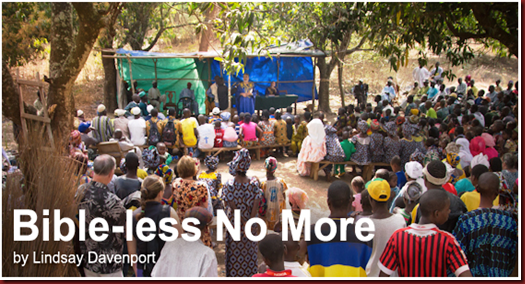
I have the privilege of serving on the board of Global Outreach for Christ, a small organization that provides support churches and individuals for Marty and Tina Ganong, Bible translators for a language in West Africa. The Ganong’s do their Bible translation through Pioneer Bible Translators (PBT). PBT recently celebrated the publication of their first full Bible translation. This week, Lindsay Davenport of PBT wrote the reflection below of the celebration that was held upon the publication of that Bible. It reminded me of how grateful to God we need to be for the numerous Bibles and translations that are available to us in English.
image

I was there as an observer. Up until this point, my closest tie to the Yalunka people was the many prayers I offered on their behalf and the numerous stories I heard about them from our president, Greg Pruett. Now I was privileged beyond words to witness these stories take on flesh before my very eyes as the Word of God came to life among them.

My eyes scanned the crowd of Yalunka men and women, hoping to absorb every snapshot of this historic moment – the dedication of the complete Bible in their language. It was actually the little things that stood out to me.

First there was the man who accepted the gift of a Bible with unbridled joy on his face. He didn't glance up from the Word for the next 15 minutes or so, opening the book and immediately beginning to read. He then struck up conversations with those around him, pointing to the text and smiling. Although I couldn't hear or understand his words, my heart sung with the realization, "He is Bible-less no more!"

Then there were the children, so curious about the many westerners who showed up for this momentous day. They were eager to hold my hands, have their picture taken and catch my attention with a smile. They are the first generation of Yalunka children to grow up with access to God’s Word in their language. As their parents become acquainted with and transformed by Scripture, so too, will they.

I watched the Yalunka church leaders unload the boxes of Bibles in front of the crowd and set them down reverently on the table. They methodically passed them out to each group of visitors according to the size of the church in their area. Some men received one or two, others were given entire boxes of Bibles to take home with them. At the conclusion of the ceremony, I choked up as these same men lifted the boxes to their shoulders and carried them off from the meeting place. I imagined the rejoicing of the saints waiting at home as the Bibles were delivered and could almost hear the sound of pages turning in church on Sunday as the pastor preached from the Yalunka Bible instead of the French.

I then observed one of our veteran missionaries open the Book, awe etched on the canvas of her face. I almost felt like an intruder on her private expression of praise for this long awaited day. She served for years as a literacy specialist among the Yalunka people, daily laboring to teach them to read so they could take ownership of the Scriptures once they were available. She placed her hand palm down on the pages of this Holy Book, closed her eyes and raised her head heavenward. The reverence in her countenance sang with mine, “They are Bible-less no more!”

Finally, my eyes caught sight of a woman standing in the back of the crowd, pulling her ear and looking intently at the ground below. As she dropped down on all fours to look for her earring, I saw Scripture played out before me - the vision of another woman sweeping her entire house in search of a lost coin (Luke 15:8). In that moment, I heard the whispers of the Father, "I am searching for every lost Yalunka soul - every…single…one."

As songs were sung in praise to God, as introductions of visitors from far away were made, as sermons were delivered and prayers prayed, my love and appreciation grew for the worldwide team who enabled this ministry among these beautiful people. We always describe the ministry of Pioneer Bible Translators as a team ministry, but the reality of this was never clearer to me than at that moment. God accomplished this work – our first completed Bible – through a team of missionaries, support personnel, donors and prayer warriors who each made sacrifices to see God’s Kingdom expand.

Together we look forward to the day when a great multitude from every nation, tribe, people and language will stand before the throne and before the Lamb (Rev. 7:9-10). On that day, none present will be mere observers, but full participants in the coming of His glory.

Saturday, March 2, 2013

“The Lord is with you, O mighty person of valor.”

clip_image002

As we journey through The Story this year, I continue to be amazed at the people we read about in the Bible who served the Lord. Many of them did extraordinary things. We have seen some of these people in the past week as we have studied the book of Judges together.

One of the people in Judges who stands out is Gideon. The secret to the amazing things he did in rescuing Israel from the Midianites can be seen in how God called him: “The angel of the Lord appeared to him and said to him, ’The Lord is with you, O mighty man of valor’” — Judges 6:12. Gideon was able to rescue Israel because the Lord was with him.

Charles Marsh, in his book Welcoming Justice, tells of Martin Luther King, Jr. having that kind of encounter with Christ:

“[In January 1956, Martin Luther King Jr.] returned home around midnight after a long day of organizational meetings. His wife and young daughter were already in bed, and King was eager to join them. But a threatening call—the kind of call he was getting as many as 30 to 40 times a day—interrupted his attempt to get some much-needed rest. When he tried to go back to bed, he could not shake the menacing voice that kept repeating the hateful words in his head.

“King got up, made a pot of coffee, and sat down at his kitchen table. With his head buried in his hands, he cried out to God. There in his kitchen in the middle of the night, when he had come to the end of strength, King met the living Christ in an experience that would carry him through the remainder of his life. ‘I heard the voice of Jesus saying still to fight on,’ King later recalled. ‘He promised never to leave me, never to leave me alone … He promised never to leave me, no never alone.’

“In the stillness of the Alabama night, the voice of Jesus proved more convincing than the threatening voice of the anonymous caller. The voice of Jesus gave him the courage to press through the tumultuous year of 1956 to the victorious end of the Montgomery Bus Boycott. More than that, it gave him a vision for ministry that would drive him for the rest of his life.”

One of the themes of the New Testament is what both Gideon and Martin Luther King, Jr. experienced — that God will be with us as he was with them and many others through the Bible and through history. Yes, God will be with you.

Later this month, we will come to this theme at the end of Jesus’ ministry. On March 24 and 31 we will take a break from The Story on Palm Sunday and Easter Sunday. On Palm Sunday, we will see in Matthew 21 how God honored Jesus in the Triumphal Entry, and on Easter Sunday, we will go to Matthew 28 and rejoice again in Jesus’ resurrection.

At the end of Matthew 28, Jesus makes the last promise of his ministry on earth when he says, “I am with you always, to the end of the age.”

You may think the people of the Bible did extraordinary things, but he is still with his people and is still doing extraordinary things through those who follow him. He can do extraordinary things in your life, too. He can influence people through you. He says to us as he did to Gideon, “The Lord is with you, O mighty person of valor.”

Wednesday, February 6, 2013

Is Your God Too Small?

clip_image002

Veteran preacher, Haddon Robinson, told the following a few years ago: “H. G. Wells was no friend of the church, but sometimes he served us well. Years ago in the New Yorker, he told a story about an Episcopalian clergyman. (He could have told it about a preacher from any denomination.) This Episcopalian bishop was the kind of man who always said pious things to people. When troubled folks came to him, he found that a particularly helpful thing to say, if said in a right tone of voice, was, ‘Have you prayed about it?’ If said in just the right way, it seemed to settle things.

“The bishop himself didn't pray much; he had life wrapped up in a neat package. But one day life tumbled in on him, and he found himself overwhelmed. It occurred to the bishop that maybe he should take some of his own advice. So, one Saturday afternoon he entered the cathedral, went to the front, and knelt on the crimson rug. Then he folded his hands before the altar (he could not help but think how childlike he was).

“Then he began to pray. He said, ‘O God--’ and suddenly there was a voice. It was crisp, businesslike. The voice said, ‘Well, what is it?’

Next day when the worshipers came to Sunday services, they found the bishop sprawled face down on the crimson carpet. When they turned him over, they discovered he was dead. Lines of horror were etched upon his face. What H. G. Wells was saying in that story is simply this: there are folks who talk a lot about God who would be scared to death if they saw him face to face. “

Robinson’s observation about this priest reminds me of a book J.B. Phillips wrote many years ago titled, “Your God Is Too Small.” We should consider whether our view of God is smaller than the view contained in Scripture.

As we have considered the early chapters of The Story in Genesis and Exodus, we come across some amazing looks at God. The early revelations of God should cause us to consider whether our view of God is big enough — or if we would be scared to death if we saw him face to face. The discussion is a critical one to have because one day we will see God face to face.

Here are some observations the early chapters of the Bible make about God:

  • The Bible opens with these words: “In the beginning, God created the heavens and the earth.” That ought to tell us everything we need to know about how big, how majestic God is. God then created every aspect of creation. If God could do that, he is indeed beyond our comprehension.
  • Noah experienced a God so great that he can cause the entire earth to be flooded, yet he saves one family with whom he reestablished the human race.
  • Abraham believed in a God so great that he went when God called him to a place that he knew nothing about. Then when called him to sacrifice his son, he believed that God could even raise him from the dead.
  • Joseph believed in a God who could turn his horrible circumstances into events that would save God’s people.

Those are only a few glimpses of God from the opening of God’s Story. We will see much more about God. Make sure your God is not too small.